Planning guide
How to Find Vacation Rentals That Welcome Large Dogs
Look beyond the pets-allowed filter to the rules, dimensions, and daily routines that make a stay workable.
By Paws & Passage Editors · Last reviewed 2026-11-16 · 11 min read
“Pet-friendly” is only the first filter
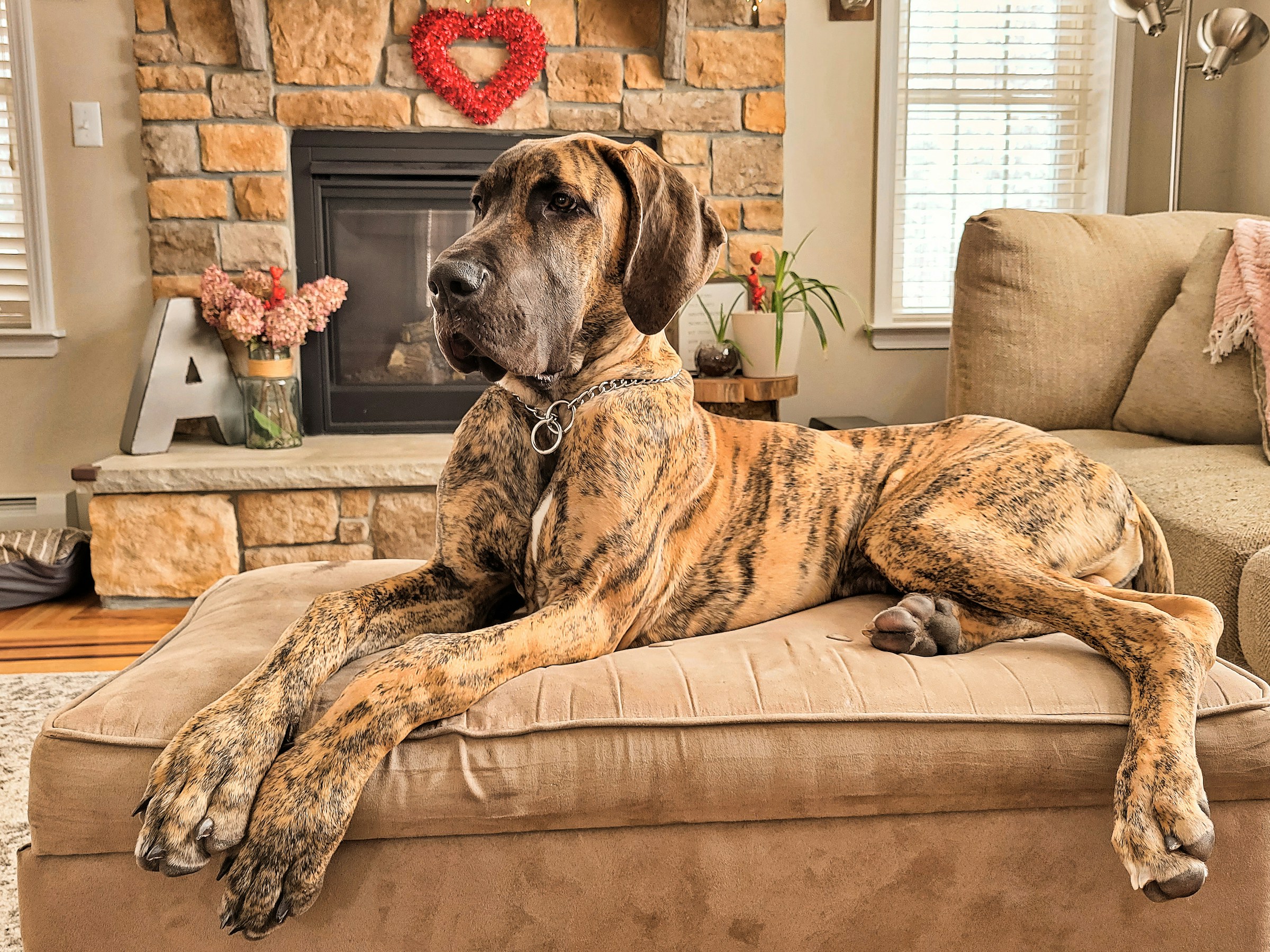
The difficult part of booking with a large dog is rarely finding a photograph of a dog beside a fireplace. It is establishing whether your particular dog is accepted—and whether the building works once you arrive.
A rental may welcome dogs but cap their weight. It may accept a large dog while putting the only sleeping area up a steep staircase. A fenced yard may be shared, and an apparently spacious living room may have nowhere to put your dog's bed without blocking a doorway.
Use two tests throughout the search:
- Permission: Do the rules explicitly allow this dog?
- Practical fit: Can this dog move, rest, toilet, and follow the household rules comfortably?
Neither test replaces the other. This guide concerns pet dogs; service animals have separate protections under applicable law and platform policy.
Write the dog's requirements before choosing a destination home
Make a short factual profile:
- Current weight.
- Breed or known mix, described honestly.
- Age and relevant mobility needs.
- Ability to manage steps and unfamiliar surfaces.
- Normal sleeping arrangement.
- Crate dimensions, if a familiar crate is part of the plan.
- Alone-time needs.
- Any management needs around other dogs or shared spaces.
Then identify nonnegotiables. For one dog, these might be a ground-floor bedroom and a short, level toilet route. For another, they might be a genuinely private outdoor area and no shared entrance with resident dogs.
Avoid making “large garden” the only requirement. An older dog may benefit more from three manageable entrance steps than from an acre reached by a steep flight.
If you are bringing another dog, combine this process with our two-dog accommodation guide. Two individually acceptable dogs may still exceed a count or combined-weight rule.
Decode weight limits literally
There is no useful universal booking definition of “large.” Different listings and directories use different thresholds. A category label does not tell you whether a specific dog qualifies.
| Listing wording | Safe interpretation | Question to resolve |
|---|---|---|
| “Dogs under 50 pounds” | A stated threshold applies | Is a dog at exactly 50 pounds accepted? |
| “Maximum 50 pounds” | The stated maximum matters | Is that per dog or combined? |
| “Large dogs considered” | Acceptance is conditional | Has this dog been approved? |
| “Any size” | No weight ceiling is stated | Are there count, breed, or other restrictions? |
| “Two dogs welcome” | Count is addressed | What size and breed rules also apply? |
| “Pets by arrangement” | Prior approval is needed | What exact conditions and charges apply? |
Do not round a dog's weight down to fit. If the dog is close to a limit, provide the current weight and ask directly. A host may have no discretion to waive a building or insurance condition.
Ask for approval that identifies the dog
A useful message is short:
“We would like to book these dates with one adult dog, currently 82 pounds, described as a Labrador–mastiff mix. Please confirm that this dog is accepted under the property's weight, breed, and building rules. We also need to confirm the entrance steps, sleeping-level access, unattended-pet policy, and total pet charge.”
If your dog's breed is unknown, say so; do not invent certainty. If you have relevant information from veterinary records, describe it accurately without presenting it as a guarantee of acceptance.
Keep the reply on the booking platform. A friendly “we love dogs” is not a clear response to a specific weight or breed question. Use the host-question tool to turn unresolved details into direct questions.
Use platform filters as discovery tools
Airbnb: add the pet and read the house rules
Airbnb's help page describes two search routes: add pets with the guest details, or use “Allows pets” under booking options. It also advises contacting the host even when pets are allowed, because restrictions can still apply. The pet policy is in the listing's House rules section. [1]
A practical sequence:
- Enter the real destination, dates, people, and pet count.
- Apply the pet-friendly filter.
- Open the house rules before spending time on décor.
- Search the listing text for “weight,” “pounds,” “breed,” “stairs,” “crate,” and “unattended.”
- Review photographs for the entrance, internal stairs, flooring, and outdoor access.
- Message the host about anything still unresolved.
The filter does not establish a no-weight-limit policy. Nor does a pet shown in a photograph prove that guest dogs of the same size are accepted.
Directories and managers: use summaries to build a shortlist
Large managers and pet-travel directories publish general pet pages, but those pages are often not where the limits live. Vacasa's pet-friendly page, for example, says weight limits and the number of dogs allowed vary by home, and that any limits are stated in each listing. [2] Treat a general page or size label as a way to find candidates, then read the full policy and confirm the final terms with the accommodation provider before booking.
Do not treat a summary as more authoritative than a conflicting current rental agreement. Ask the provider to resolve the discrepancy; save the answer.
Local managers: search their actual policy vocabulary
Some regional managers organize inventory by their own size categories. One reviewed manager uses a specific “Dogs Over 30lb” filter, illustrating why a general “large dogs” search may miss relevant inventory. That is a discovery example, not a recommendation of its homes. [3]
Useful searches include:
- Destination plus “dogs any size vacation rental.”
- Destination plus “no weight limit dogs.”
- Destination plus “large dogs considered.”
- Destination plus “pet policy pounds.”
- Destination plus “ground floor dog friendly rental.”
These phrases surface candidates, not guarantees. Read the actual policy attached to the home.
Vrbo and other booking sites: resolve details at listing level
Use the available pets-allowed controls and enter your animal information accurately. Then inspect the property's house rules, fee details, and rental terms.
Avoid depending on a remembered app layout: interfaces and regional displays change. The dependable technique is to identify the pet policy, locate any size or breed conditions, and obtain written confirmation for your dog before payment.
Check the route through the property
“Single level” does not necessarily mean step-free. A home can have no internal staircase but sit above a steep driveway or a long external flight.
Think in routes:
- Parking to entrance.
- Entrance to resting area.
- Resting area to the permitted bedroom.
- Bedroom to the nearest nighttime toilet area.
- Indoor space to any yard.
Ask for current photographs or a short description of each route. If dimensions matter, request measurements rather than relying on a wide-angle photograph.
Stairs and lofts
Find out:
- How many entrance steps there are.
- Whether steps are open-backed or unusually steep.
- Whether the only bedroom is upstairs.
- Whether a loft is reached by a ladder or narrow stair.
- Whether dogs are prohibited from the sleeping level.
- Whether a gate can be used without damaging walls.
- Whether a lift exists and is available throughout the stay.
Do not build the plan around carrying a heavy dog unless that is genuinely safe and practical for the people traveling. Consider the return from a wet walk, a minor injury, or a tired evening—not only the dog's best day.
For a dog with pain or mobility problems, ask your veterinarian what access arrangements are appropriate. A property description cannot substitute for that advice.
Flooring
Photographs often reveal a broad surface type but not its traction. Ask whether the main route is polished wood, tile, stone, carpet, or another material, and whether rugs shown in photographs remain in place.
A non-slip runner or familiar mat may be useful if the host permits it and it can be laid securely without creating a trip hazard or damaging the floor. Do not assume that loose towels are an adequate solution.
Check where the dog will rise from bed, turn near doors, and wait after a walk. Those small areas may matter more than the size of the room.
Measure the space your dog actually uses
A large bed, familiar crate, or travel mat can occupy more usable floor space than expected.
Record:
- Bed length and width.
- Crate exterior dimensions.
- Clearance needed to open a crate door.
- Space needed to walk around the resting area.
- Any narrow doorway or corridor on the access route.
Ask whether you may reposition small furniture if necessary, and restore it before departure if permitted. Do not assume you can move heavy furniture or remove decorative items without agreement.
If dogs are prohibited from sofas and beds, make sure there is a comfortable permitted resting location near you. A loft bedroom with the dog required downstairs may not suit your normal arrangement or your dog's demonstrated ability to settle.
Our vacation-rental checklist helps connect these physical details to the house rules.
Understand breed restrictions without guessing the reason
Some restrictions come from owners. Others may reflect an insurer, association, lease, or building policy. Do not assume which applies to a particular listing unless the host explains it.
The Insurance Information Institute reports that insurers vary: some restrict certain breeds, some assess individual dogs, and some do not ask about breed. That variation is why “insurance won't allow it” is not a universal description of insurance—but it can reflect a real restriction for a particular property. [4]
A sensible response is to ask:
“Is this a firm property or insurer restriction, or can you approve this individual dog in writing?”
If the answer is no, move on. Concealing the dog's size or breed creates a booking risk rather than solving one. Do not seek a vague verbal exception that conflicts with the written agreement.
Separate health insurance from liability cover
A pet health policy is not the same product as liability protection for injuries or damage your dog causes. The Insurance Information Institute distinguishes pet health coverage from other financial protections. [5]
Ask your own insurer whether any relevant liability coverage extends to a temporary rental, and whether exclusions apply to your dog or the intended activity. Do not assume that a policy name, a host's damage program, or a travel policy means every loss is covered.
A refundable deposit or paid damage waiver is also not blanket permission for damage. Read its terms and limits.
Check the yard for this dog, not an average dog
A “fenced” filter is not a security inspection.
Ask about:
- The lowest fence section.
- Gate height, latches, and gaps underneath.
- Shared access for guests, gardeners, or neighbors.
- Whether the entire boundary is enclosed.
- Retaining walls, furniture, or slopes that reduce effective height.
- Access to pools, roads, livestock, or wildlife.
- Whether dogs must remain supervised outside.
Do not choose a fence height based solely on body weight. Jumping, climbing, digging, squeezing, and reacting at boundaries are individual behaviors.
Request current boundary photographs when the yard is essential. Inspect it on arrival before releasing the dog. Our secure fenced-yard guide provides a fuller assessment framework.
A property without a yard may still work if it has a safe toilet route and suits your daily plans. Conversely, a large garden is not a good trade for unsafe stairs or a dog-size prohibition.
Match unattended rules to your itinerary
VCA's guidance is written for hotels rather than rentals, but the principle carries over. It advises verifying that the hotel allows a pet to stay in the room alone, and notes that some establishments have size or number limits and some have more stringent housekeeping rules. Apply it to a rental as a prompt to ask, not as a rule the rental must follow. [6]
Ask whether:
- Dogs may ever be left unattended.
- Crating is required.
- A visiting caregiver is permitted.
- Any time limit applies.
- Specific areas of the property are off-limits.
Then assess what your dog can actually manage. A large crate is not a solution for a dog who is not comfortable being crated. A camera does not make a prohibited arrangement permissible.
Choose activities that work with the answer. If the main purpose of the trip requires long dog-free periods, arrange permitted care before booking rather than hoping the dog settles.
Compare the complete cost of a workable stay
“No weight limit” does not mean “no pet fee,” and a higher fee does not prove a property offers better facilities.
Calculate the full accommodation total with the actual pet count, dates, cleaning charges, and applicable taxes. Keep refundable deposits or holds separate so you can distinguish trip cost from cash required.
Use the cost calculator and pet-fee guide. Then compare practical trade-offs in the comparison tool.
A hypothetical example: a cheaper rental with an unsuitable sleeping-level arrangement is not a bargain if it requires an unplanned change of accommodation. A slightly smaller ground-floor home may fit your dog better than a dramatic multi-level cabin.
The useful comparison is not “luxury versus basic.” It is “works without improvisation versus requires daily workarounds.”
Common mistakes that waste search time
Starting with photographs rather than restrictions
Check count, weight, breed, and unattended rules first. Save the kitchen photographs for listings that pass.
Treating “large dogs considered” as approval
It means ask. Obtain an answer identifying your dog and dates.
Assuming a host can waive every rule
A host may not control association or insurance conditions. Ask whether an exception is possible, then respect the answer.
Ignoring the sleeping arrangement
A dog prohibited upstairs may struggle if all people sleep in a loft. Resolve this before booking.
Overvaluing acreage
Private land is not automatically enclosed or safe for off-lead use.
Hoping a refund will follow a mismatch
Cancellation and dispute outcomes depend on the booking terms and circumstances. Prevention is more reliable than assuming a later remedy.
A final large-dog booking checklist
- The host has the dog's accurate current weight and description.
- Count, individual weight, combined weight, and breed rules are clear.
- Any exception is explicit and recorded in writing.
- Entrance steps and sleeping-level access are suitable.
- Flooring and resting locations work for the dog.
- Bed or crate dimensions fit without blocking exits.
- Outdoor access is practical at night and in poor weather.
- Yard claims have been checked rather than assumed.
- Unattended rules match the trip's care plan.
- The full price and deposit arrangements are understood.
- Cancellation terms are acceptable.
Save those decisions in the trip checklist. Once a place clears the rules and the practical-fit test, you can choose between views, kitchens, and proximity to walks with much more confidence.
Questions people ask
Can I filter vacation rentals by my dog's weight?+
Some specialist directories and local managers offer size labels or weight-based categories. A general pets-allowed filter does not establish that your dog's weight is accepted. Check the individual policy and ask the host.
What does 'large dogs considered' mean?+
It means acceptance is conditional rather than guaranteed. Send your dog's accurate weight and description and obtain explicit written approval before booking.
Why do rentals have breed restrictions?+
The reason may be an owner decision, insurer condition, association rule, or another property requirement. Insurance practices vary, so ask what applies to that listing instead of assuming a universal rule.
Is a ground-floor rental always step-free?+
No. There may be external steps, a steep approach, thresholds, or an upper-level entrance. Ask about the complete route from parking to the entrance and from the sleeping area to outdoor access.
Does pet health insurance cover damage to a rental?+
Do not assume so. Pet health insurance and liability protection are different forms of coverage. Ask your insurer about the exact policy, rental setting, exclusions, and limits.
Sources and how we researched this
Before writing, we reviewed 5 of the pages that currently rank for this topic, noted what they leave out, and checked facts against the official sources below. We haven't stayed at or inspected any property for this guide. Read our editorial standards.
- Finding places that allow pets (Airbnb, accessed 2026-11-16)
- Pet-friendly vacation rentals (Vacasa, accessed 2026-11-16)
- Pet Friendly - Large Dogs (Sun Palace Vacation Homes, accessed 2026-11-16)
- Spotlight on: Dog bite liability (Insurance Information Institute, accessed 2026-11-16)
- Facts about pet insurance (Insurance Information Institute, accessed 2026-11-16)
- Traveling With Your Pet: Pet-Friendly Hotels (VCA Animal Hospitals, accessed 2026-11-16)
Keep reading
Planning
Traveling With Two Dogs: The Accommodation Planning Guide
Book for two individual dogs—not just a listing that happens to allow pets.
11 min read · Reviewed 2026-11-16

Planning
How to Find a Vacation Rental With a Truly Secure Fenced Yard
Look past the lawn photo: check the weakest boundary, the gate routine, and the evidence that matters for your dog.
11 min read · Reviewed 2026-11-16
Checklist
What to Check Before Booking a Pet-Friendly Vacation Rental
A practical booking audit for the dogs you have, the trip you want, and the rules you can actually follow.
13 min read · Reviewed 2026-11-16