Gear guide
Dog Travel Water and Feeding Gear: Bowls, Bottles and Food Containers
Pick bowls, water bottles and food containers by how you travel, then handle heat, water and food storage the way park and animal-welfare guidance says to.
By Paws & Passage Editors · Last reviewed 2026-11-16 · 13 min read
Start with the trip, not the product
Most travel-gear roundups open with a list of bowls. The more useful question is where your dog will actually eat and drink.
A day on a trail, a car ride with long stretches between stops, and a week in a mountain cabin all call for different equipment. The same dog needs water on all three, but the right bowl, the right bottle and the right way to store kibble change with each.
This guide covers three categories: collapsible bowls, travel water bottles or dispensers, and food containers for cabins and road trips. It also covers the parts that gear cannot fix on its own, such as heat, unfamiliar water and keeping dog food away from wildlife. Those come from public guidance by the CDC, the ASPCA, the National Park Service and BearWise, and each claim is cited to its source.
One thing to know up front: the picks in this guide are chosen on criteria and on specifications published by each maker. They are not the result of Paws & Passage trying the products. We explain exactly how that works in the section on how we choose and how this site earns money.
Hydration and heat come first
Gear is only useful if it gets water into a dog that needs it. Two points from official guidance frame every choice below.
Pack water for the trip
The CDC's pet travel page tells people travelling by car to pack water and food along with a bowl, leash, waste bags and the rest of a travel kit. [1] The ASPCA gives the same advice with an extra reason: it recommends bottled water or water from home on a road trip, because drinking water from an area a pet is not used to could cause an upset stomach. [2]
That has a practical consequence for gear. A bottle is not only a convenience for a walk; it is how you carry familiar water to a rest stop, a trailhead or a rental where you are unsure about the tap. Plan your container capacity around the length of your longest gap between refills rather than around the size of the dog's bowl.
Heat builds faster than most people expect
The ASPCA says pets can become dehydrated quickly when it is hot or humid and should be given plenty of fresh, clean water. [3] It also advises giving pets a shady place out of the sun and avoiding letting dogs linger on hot asphalt, where paw pads can burn. [3]
The CDC is direct about parked vehicles: never leave a pet alone in one, and on hot days temperatures can rise within minutes and cause death. [1] The ASPCA adds that cracking a window is not adequate because the car heats at almost the same rate, and that flat-faced breeds such as Pugs and French Bulldogs are especially vulnerable to heat exhaustion. [2]
No bottle or bowl changes that. If your plan depends on leaving the dog in the vehicle with a bowl of water while you eat or shop, the plan needs to change, not the gear.
Know the warning signs
The ASPCA lists heatstroke signs including excessive panting or difficulty breathing, an increased heart and respiratory rate, drooling, mild weakness, stupor or collapse. [3] It lists flat-faced breeds, older pets, overweight pets and pets with heart or lung disease among those that should stay in air-conditioned rooms as much as possible during extreme heat. [3]
If you suspect heatstroke, contact a veterinarian right away. This guide is not veterinary advice, and the right amount of water or the right feeding routine for your dog is a question for your own vet.
Water at lakes, pools and beaches
When you are near pools, lakes or the ocean, the ASPCA says to bring fresh water and keep pets from drinking pool or ocean water. [3] That is a good use of a squeeze bottle: it lets you offer a drink on your terms every time your dog heads for the shoreline.
What to look for in a collapsible bowl
A travel bowl lives in a door pocket, a backpack or a cupholder, gets stepped on, and often goes back into the bag damp. The features that matter follow from that.
Capacity that matches the gap between refills. A bowl that holds a couple of cups is fine for a short stop. For a large dog on a hot day, a small bowl means refilling repeatedly, which is a real nuisance at a trailhead. Capacity is listed in ounces or cups on a maker's page; compare it to how much you expect your dog to drink in one stop.
Material and cleaning. Silicone and coated fabrics are the common choices. Silicone is generally simple to rinse and can often go in the dishwasher; coated fabrics pack smaller but may need hand washing. Read the care instructions on the maker's own page because they differ even between similar-looking bowls.
Stability. A collapsible bowl that tips when your dog leans on it wastes water. Wider bases and thicker walls help; a thin fabric bowl can sag unless full.
Packed size. Some bowls flatten to about the thickness of a coaster. If you are carrying a bag on a long hike, that matters more than any other feature.
A clip or loop. A carabiner or loop makes it far more likely the bowl is actually within reach when needed.
A note on elevated or slow feeders
Some roundups say raised bowls reduce bloat risk. We do not repeat that; our sources do not make that claim, and no travel bowl replaces your veterinarian's advice, especially for deep-chested breeds.
The CDC does give one feeding-schedule tip that is relevant to car travel: feed your pet three to four hours before leaving on a trip to help prevent car sickness or vomiting. [1] The ASPCA likewise says not to feed a pet in a moving vehicle, and on longer rides to offer only an occasional small snack. [2]
What to look for in a travel water bottle or dispenser
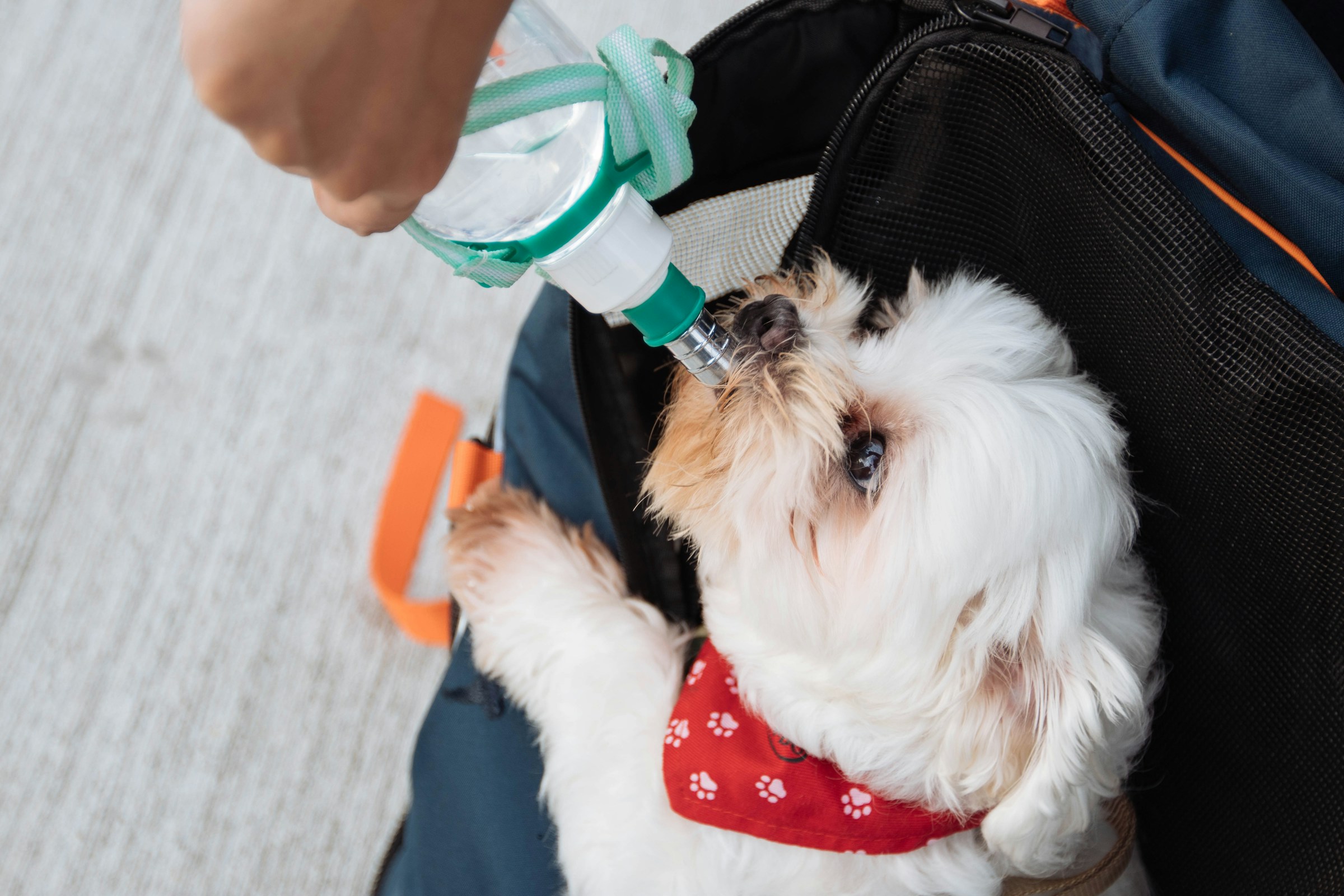
A water bottle with an attached bowl solves a different problem than a collapsible bowl. It carries the water and serves it in one object, so you can offer a drink with one hand while holding a leash.
There are two common designs:
- Squeeze-to-fill. You squeeze the bottle and water rises into an attached bowl; releasing the squeeze lets the unused water drain back into the bottle. This wastes little water and is easy in a car.
- Flip-up bowl. A silicone bowl on top of the bottle flips up for drinking and folds down for storage. It is more compact but offers a smaller drinking surface.
Whichever design you choose, check:
- Capacity relative to your dog's size and your longest gap between refills.
- Leak claims. Makers use different wording, and a statement that a lock design is leak-proof is a description by the maker, not a guarantee for your bag. Keep the bottle upright or in a side pocket when it is full.
- Cleaning. Bottles with attached bowls have more crevices than a plain bottle. Look for makers that say whether the bottle is dishwasher safe, and which rack.
- Hand fit. If you will operate it one-handed while holding a leash, the shape and the squeeze force matter. Maker pages cannot tell you this, so read the maker's description and check return terms.
What to look for in a food container for road trips and cabins
Travel food containers do two jobs: keep kibble dry and fresh, and keep it away from anything that would like to eat it. Those goals can pull in different directions, which is why one container rarely does both.
Airtight is not the same as wildlife-resistant
Makers use "airtight" to describe a seal that limits air and moisture. That is useful for freshness. It does not mean a container will stop a determined animal, and it does not mean the food no longer smells.
BearWise notes that pet food is rich in fat and protein, which makes it extremely attractive to bears. [5] Its guidance for pet food has a few clear rules:
- Feed pets indoors when possible.
- If you must feed outdoors, feed single portions and remove food and bowls afterward.
- Bring bowls inside at night.
- Store pet food where bears cannot see or smell it.
- Do not leave food out for stray animals. [5]
BearWise also points out that a bear can drag pet food bags away, and says storing pet food in a screw-top container will keep black bears out of it. [5]
None of the products in this guide claims to be bear-resistant, so treat them as freshness and organization tools, not as wildlife protection. If you are in bear country, the main protection is where the container is kept, not what it is made of.
What the National Park Service says
The National Park Service's food storage page treats a broad range of scented items, including ice chests, as food that must be stored properly. It tells visitors to keep food within arm's reach in picnic areas and campgrounds, to keep food inside the room when staying in cabins and hotels, and to close windows and doors when leaving. [4]
On vehicles, the page says rules vary by park: some allow food inside a car if it is out of sight with the windows closed, while others require lockers. It says food must never be stored in a pickup truck bed or strapped to the outside of a vehicle. [4] Breaking the rules can mean fines, confiscation of food, towing or other penalties. [4]
That page does not name pet food specifically. We are not claiming it does. The conservative approach, consistent with BearWise, is to treat dog food and treats like any other food and to ask the park or the host what is required before you arrive.
Cabin and rental routine
At a cabin or vacation rental:
- Keep the food container and bowls inside, in a closed room or cupboard, not on a porch or deck.
- Feed indoors, pick up bowls after meals and rinse them.
- Take treats and dog food out of the car overnight if the local rules or the host ask you to, and keep it out of sight if you are told to leave it in.
- Ask the host what is expected. Our host-question tool includes prompts for exactly this sort of rule.
For more on what else to pack for a cabin stay, see our dog-friendly cabin packing list.
Size the container to the trip
For a weekend, a small container or soft bag holding a few days of food is easier to carry than a large bin. For a longer trip or when you are bringing a large dog's full supply, a rigid container that keeps food dry is more useful, but takes more car space.
Keep the original bag information handy if you can. Lot numbers and best-by dates are useful if a recall is announced, and decanting food can separate you from that information. Taking a quick photo of the bag's label before you pour is a simple workaround.
Our five picks
Each product below was chosen because its maker's own page states specifications that match the criteria above. These are criteria- and spec-based picks, not tested picks. We have not used these products and make no claim about how they perform in your hands. Specifications come from the maker's page accessed on 16 November 2026; check that page again before you buy because designs change.
Kurgo Collaps A Bowl
The maker lists a 24-ounce capacity, a collapsed height of less than one inch, food-grade silicone described as PVC and BPA free, and top-rack dishwasher safety. It also states a Lifetime Guarantee covering manufacturing defects.
It earns a place because the spec list covers the practical points from our bowl criteria in a single product: modest capacity, very flat when collapsed, a cleaning instruction that is easy to follow, and a stated warranty. The trade-off is size: 24 ounces is small for a large dog on a hot day.
Springland 22oz Original Travel Dog Water Bottle
This is the squeeze-to-fill design. The maker says you squeeze to fill the attached bowl and release to drain the excess back into the bottle, using one hand. It describes food-safe, BPA-free polypropylene plastic with an aluminum carabiner and a leak-proof lock design, and says it is dishwasher safe on the top rack only. The page notes that it was formerly called the Springer Dog Travel Water Bottle.
It suits car trips and walks where you want to pour water without a separate bowl. The caution is the same as for any bottle with a bowl: more parts to clean, and the maker's "leak-proof" wording is a description, not a promise.
Springland 20oz Flip Travel Dog Water Bottle
The flip design uses a silicone top bowl that flips up to drink and folds down for storage. The maker lists the same BPA-free polypropylene body, aluminum carabiner, leak-proof lock design and top-rack dishwasher care as the Original, with a 20-oz capacity.
We include it as an alternative for people who prefer the compact shape. The silicone bowl is a smaller drinking surface than a separate collapsible bowl, so watch how your dog uses it.
Vittles Vault Travel-Tainer Portable Food Storage Container
The maker describes a 6-cup container with two 3-cup bowls, one for food and one for water, plus a carry handle. It states the plastic is food-grade and BPA-free and that the container has an airtight seal. It also says the bowls are dishwasher safe but the clear food container is not, and that actual capacity depends on kibble shape and density.
It fits the "one rigid kit for a cabin or camp weekend" situation: food, a seal and two bowls in one package. Six cups holds a limited supply, so it is not a bulk-storage answer for a big dog on a long trip, and as discussed above an airtight seal is not wildlife protection.
Kurgo Kibble Carrier
The maker lists a capacity of up to 5 lbs of dry food, roughly 20 cups of average-sized kibble. It describes ripstop material with a food-safe PEVA liner and heat-sealed seams, a roll-top that rolls and clips with a simple buckle closure, and hand-wash, air-dry care.
It is a packing tool: lighter and easier to squeeze into a bag than a rigid bin. The trade-off is that a soft bag offers no protection against a determined animal and the maker does not claim any, so keep it inside, as described above.
Pick by situation
| Situation | What matters most | Pick to look at |
|---|---|---|
| Day hike with one dog | Packed size, a clip, a way to serve water | Kurgo Collaps A Bowl plus a bottle |
| Long car trip, frequent stops | Water you can serve one-handed, familiar water from home | Springland 22oz Original Travel Dog Water Bottle |
| Short walks and compact bag | Smallest package that still gives a bowl | Springland 20oz Flip Travel Dog Water Bottle |
| Cabin or camp weekend | Food, seal and bowls together | Vittles Vault Travel-Tainer |
| Backpacking with a few days of kibble | Weight and packability | Kurgo Kibble Carrier |
| Bear country | Where food is kept matters more than the container | Any of the above, stored indoors or as directed by the park |
| Beach, lake or pool | Fresh water so your dog is not tempted to drink from the shoreline | Either Springland bottle or the Kurgo bowl |
| Large dog on a hot day | Capacity and refills | A larger bowl than the small ones above; check capacity on the maker's page |
If you are travelling with two dogs, the water supply is the first thing to double. Our two-dog travel guide covers other planning points, and large dogs bring their own considerations in our large-dog rental guide.
A simple packing list for water and feeding
Put these in one bag so you do not have to hunt for them at a rest stop:
- Water from home or bottled water, in a bottle you can serve one-handed.
- A collapsible bowl or bottle with attached bowl.
- Dog food in a sealed container or bag, plus a second bag or container for treats.
- A photo of the food bag label for lot and best-by information.
- Waste bags, a towel to wipe bowls, and a small bottle of dish soap for cabins.
- Any medications your vet has prescribed.
The CDC's own list also includes a leash, grooming supplies, first-aid items and travel papers such as proof of rabies vaccination. [1] Add these items to our trip checklist so nothing is forgotten, and see our rental checklist for what to confirm with the host.
Common mistakes
Leaving the dog in the car "for a minute." Vehicles heat within minutes, and cracked windows do not solve it. [1] [2]
Treating airtight as animal-proof. Freshness and wildlife resistance are different properties.
Leaving bowls and food on a porch. BearWise says to bring bowls inside at night. [5]
How we choose and how this site earns money
We pick products using the criteria in this guide, and we check each product's specifications on its maker's own page. We record the page and the date we read it. We do not state prices, because they change, and we do not publish ratings.
We have not tested these products, and we do not claim they are the best available. A product can meet the criteria and still not suit your dog.
This site may earn a commission if you buy through an affiliate link, at no extra cost to you. At the time this guide was published, none of the products has an active affiliate link. If that changes, any button will be marked as sponsored. Read the details on our affiliate disclosure page.
Final checklist
- Water from home or bottled water is packed, with a bottle you can serve easily.
- You know the longest gap between water stops and your containers cover it.
- The dog is never left alone in a parked vehicle.
- Food is in a sealed container or bag, with the label information photographed.
- You have asked the host or park what is required for food storage.
- Food, bowls and treats stay indoors or as directed, never on a porch or deck.
- Bowls and bottles are rinsed and dried during the trip.
- Your vet has answered any feeding or hydration questions specific to your dog.
Choose gear for how you travel, and follow the official guidance for heat and wildlife.
Our picks
We haven't tested these products. They were chosen against the criteria above using the maker's published specifications and independent standards, which are linked for each one.
A flat, simple bowl for day trips and door pockets
Kurgo Collaps A Bowl
A single collapsible silicone travel bowl for water or food that flattens for a bag or door pocket.
The maker's page lists a 24-ounce capacity, a collapsed height under one inch, food-grade silicone described as PVC and BPA free, top-rack dishwasher safety and a Lifetime Guarantee for manufacturing defects. That covers capacity, packed size, cleaning and a stated warranty in one listing.
- Holds 24 ounces
- Collapses to less than 1 inch high
- Food-grade silicone, described by the maker as PVC and BPA free
- Dishwasher safe on the top rack, per the maker
- Backed by the maker's Lifetime Guarantee covering manufacturing defects
Check before you buy
- 24 ounces is small for a large dog on a hot day, so plan for refills or a bigger bowl.
- Top-rack dishwasher only, per the maker.
- Spec-based pick, not tested by Paws & Passage.
Specs from Collaps A Bowl (Kurgo, accessed 2026-11-16). Sizes, models and availability change: confirm on the seller's page.
One-handed water service on car trips and walks
Springland (formerly Springer) 22oz Original Travel Dog Water Bottle
A squeeze-to-fill water bottle with an attached bowl, designed to be operated with one hand.
The maker describes a squeeze-to-fill design that drains unused water back into the bottle, food-safe BPA-free polypropylene, an aluminum carabiner and a leak-proof lock design. It addresses the need to carry familiar water and serve it easily.
- 22 oz capacity
- Squeeze to fill the attached bowl, release to drain the excess back into the bottle
- Food-safe, BPA-free polypropylene plastic; aluminum carabiner included
- Described by the maker as having a leak-proof lock design
- Dishwasher safe on the top rack only; hand washing with dish soap also listed
Check before you buy
- Attached bowls add crevices to clean; the maker lists top-rack dishwasher safety or hand washing.
- Leak-proof is the maker's wording, so keep a full bottle upright in a bag.
- Sold under the Springland name; the page says it was formerly called Springer.
Specs from 22oz Original Travel Dog Water Bottle (Springland, accessed 2026-11-16). Sizes, models and availability change: confirm on the seller's page.
A compact bottle with a fold-down bowl
Springland (formerly Springer) 20oz Flip Travel Dog Water Bottle
A squeeze-to-drink water bottle topped with a silicone bowl that flips up for drinking and folds down for storage.
The maker describes a silicone top bowl that flips up to drink and folds down for storage, with a BPA-free polypropylene bottle, aluminum carabiner and leak-proof lock design. It offers a more compact alternative to the squeeze-to-fill design.
- 20 oz capacity
- Silicone top bowl flips up to drink and folds down for compact storage
- Food-safe, BPA-free polypropylene plastic; aluminum carabiner included
- Described by the maker as having a leak-proof lock design
- Dishwasher safe on the top rack only; hand washing with dish soap also listed
Check before you buy
- The silicone bowl is a smaller drinking surface than a separate collapsible bowl.
- Top-rack dishwasher only, per the maker.
- Spec-based pick, not tested by Paws & Passage.
Specs from 20oz Flip Travel Dog Water Bottle (Springland, accessed 2026-11-16). Sizes, models and availability change: confirm on the seller's page.
A cabin or camp weekend where food and bowls travel together
Vittles Vault (Gamma2 / Petmate) Vittles Vault Travel-Tainer Portable Food Storage Container
A rigid food container with a sealing lid that comes with two bowls and a carry handle.
The maker lists a 6-cup container with an airtight seal, two 3-cup bowls and a carry handle, made from plastic it describes as BPA-free and food-grade. It combines storage and serving in one kit.
- 6-cup food container (the maker notes actual capacity depends on kibble shape and density)
- Comes with two 3-cup bowls, one for food and one for water, and a carry handle
- Described by the maker as made from BPA-free, food-grade plastic with an airtight seal
- Maker says the bowls are dishwasher safe but the clear food container is not
Check before you buy
- Six cups is a limited supply and the maker notes capacity depends on kibble shape and density.
- The maker says the clear food container is not dishwasher safe, though the bowls are.
- Airtight is a freshness feature, not wildlife protection; keep it indoors in bear country.
Specs from Vittles Vault Travel-Tainer Portable Food Storage Container (Petmate, accessed 2026-11-16). Sizes, models and availability change: confirm on the seller's page.
Packing a few days of kibble where weight and space matter
Kurgo Kibble Carrier
A soft roll-top bag for carrying a few days of dry food, built for packing rather than long-term storage.
The maker lists up to 5 lbs of dry food, ripstop material with a food-safe PEVA liner, heat-sealed seams and a roll-top that rolls and clips. It is a soft, packable option for short trips.
- Holds up to 5 lbs of dry food, roughly 20 cups of average-sized kibble, per the maker
- Ripstop material with a food-safe PEVA liner and heat-sealed seams
- Roll-top closure that rolls and clips, with a simple buckle closure
- Hand wash, then air dry
Check before you buy
- Hand wash and air dry only, per the maker.
- A soft bag offers no stated protection against animals; store it indoors.
- Five pounds is a short supply for a large dog or a long trip.
Specs from Kibble Carrier (Kurgo, accessed 2026-11-16). Sizes, models and availability change: confirm on the seller's page.
Questions people ask
Should I bring water from home for a road trip with my dog?+
The ASPCA recommends bottled water or water from home on a road trip because drinking water from an unfamiliar area could upset a pet's stomach. Pack enough for the longest gap between stops.
Is it safe to leave my dog in the car with water and the windows cracked?+
No. The CDC says never to leave a pet alone in a parked vehicle because temperatures can rise within minutes and cause death on hot days. The ASPCA says cracking a window is not adequate because the car heats at almost the same rate.
Does an airtight dog food container keep wildlife out?+
Not necessarily. Airtight describes a seal against air and moisture, which helps with freshness. BearWise says pet food is highly attractive to bears and recommends feeding indoors and storing food where animals cannot see or smell it. None of the products in this guide claims to be bear-resistant.
Can I leave dog food in my car at a national park?+
It depends on the park. The National Park Service says some parks allow food stored out of sight inside a car with the windows closed, while others require lockers, and food must never be left in a truck bed or strapped to the outside of a vehicle. Its page does not name pet food, so check the specific park's rules before you go.
Do travel water bottles with attached bowls leak?+
The makers of the bottles in this guide describe a leak-proof lock design, but that is the maker's own description and we have not tested it. Keep a full bottle upright and check the maker's return terms.
Are these picks tested by Paws & Passage?+
No. They are chosen on criteria and on specifications taken from each maker's own page. We have not tested them and do not claim they are the best available.
Sources and how we researched this
Before writing, we reviewed 6 of the pages that currently rank for this topic, noted what they leave out, and checked facts against the official sources below. We haven't stayed at or inspected any property for this guide. Read our editorial standards.
- Pet Travel Safety (Centers for Disease Control and Prevention, accessed 2026-11-16)
- Traveling With Pets? Follow These Expert Dos and Don'ts to Keep Them Safe (ASPCA, accessed 2026-11-16)
- Hot Weather Safety Tips (ASPCA, accessed 2026-11-16)
- Storing Food (National Park Service, accessed 2026-11-16)
- Never Leave Pet Food Outdoors (BearWise, accessed 2026-11-16)
Keep reading
Checklist
What to Pack for a Dog-Friendly Cabin Vacation
A practical packing list for muddy entrances, unfamiliar stairs, quiet nights, and the things a remote cabin cannot supply.
12 min read · Reviewed 2026-11-16
Checklist
What to Check Before Booking a Pet-Friendly Vacation Rental
A practical booking audit for the dogs you have, the trip you want, and the rules you can actually follow.
13 min read · Reviewed 2026-11-16
Planning
Traveling With Two Dogs: The Accommodation Planning Guide
Book for two individual dogs—not just a listing that happens to allow pets.
11 min read · Reviewed 2026-11-16