Destination guide
Dog-Friendly Cabins With Fenced Yards in Georgia
A mountain view is easy to judge from a photograph. A yard that works for your dog takes a few better questions.
By Paws & Passage Editors · Last reviewed 2026-11-16 · 12 min read
Start with the enclosure, not the view
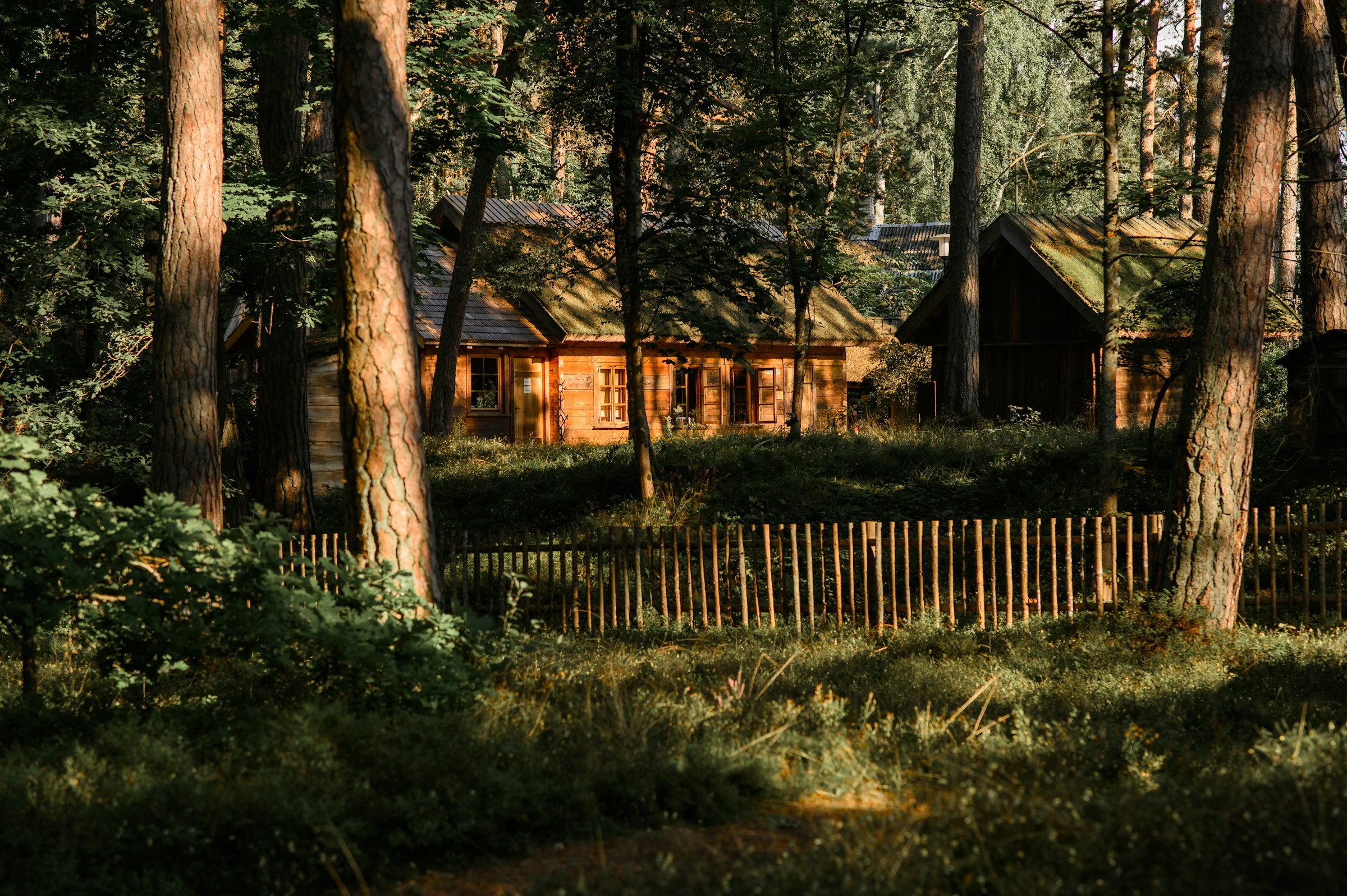
For a dog-friendly cabin in Georgia, “fenced yard” should be the beginning of your questions, not the end. Your useful question is more specific: can your particular dog move from the cabin into a private outdoor area without encountering an open driveway, an unsuitable flight of stairs, or a gap in the boundary?
Airbnb advises guests to contact the host even when a listing allows pets, tell the host about the pets you are bringing, and ask whether restrictions apply. Airbnb’s host guidance lists a fenced-in yard or a private patio among the pet-related features guests may want to know about. Neither a pet-friendly filter nor a photograph of one fence section answers all your enclosure questions. [1] [2]
This guide is a booking method, not a list of endorsed cabins. No rental has been inspected or tested for this article. Use it when comparing listings around Blue Ridge, Ellijay, Helen, Dahlonega, and the surrounding North Georgia mountains.
The aim is not to find an imaginary escape-proof property. It is to understand the layout, identify unacceptable compromises before paying, and arrive with a workable backup plan.
Decide what your dog actually needs
Write down your non-negotiables before looking at attractive interiors.
For one dog, a small enclosed toilet area directly outside the kitchen might be enough. For another, that same space could be frustrating because the usable ground is steep, neighboring dogs are visible through the fence, or access requires several stairs.
Separate your needs into three groups:
- Containment: the boundary height, openings, ground clearance, gates, and access route.
- Usability: footing, slope, shade, lighting, stairs, and enough appropriate space for your intended use.
- Management: privacy, service visits, pet rules, supervision, and an alternative if the enclosure disappoints.
Do not choose a universal minimum fence height from a travel article. Tell the host about your dog’s size and behavior, then ask for measurements. A dog that digs, climbs, jumps, squeezes, or rushes gates needs a different assessment from a dog that stays beside you.
For a more detailed boundary audit, use our secure fenced-yard guide. If you are bringing more than one dog, read the two-dog accommodation guide before shortlisting.
What does “fenced” mean in this listing?
Ask the host to identify the exact enclosed area on a photograph or simple sketch. Do not assume that the acreage advertised with the cabin is the acreage inside the fence.
Compare the outdoor layouts
| Listing description | What you need to establish | Booking question |
|---|---|---|
| Fenced yard | A continuous boundary around the usable ground | “Can you show every side and every gate?” |
| Fenced dog run | Its dimensions, surface, and access route | “Is this intended for toilet breaks, exercise, or both?” |
| Gated deck | Whether there is any enclosed ground beyond it | “Does the gate lead into a fenced yard or onto open land?” |
| Private outdoor space | Whether private also means enclosed | “Is there a physical boundary all the way around?” |
| Shared fenced area | Who else uses it and how access works | “Can other guests or dogs enter while we are using it?” |
These are questions for an individual booking, not standardized promises attached to those phrases.
A helpful host response is concrete: the shortest fence measurement, the widest opening, the number of gates, the route from the door, and recent photographs. “We have never had a problem” is reassuring in tone but does not tell you whether the layout fits your dog.
Request a continuous perimeter video
Ask for a short video beginning at the cabin door and following the route into the yard. Then ask the host to walk the entire boundary and show:
- Every gate, including any vehicle gate.
- The bottom of the fence where the ground changes level.
- Corners and joins between different fence materials.
- Drainage openings and gaps beside buildings.
- The connection between the fence, deck, stairs, and house.
- Objects or sloping ground beside the boundary.
- The area outside the fence, including roads and neighboring spaces.
Treat an old video as a starting point. Ask when it was recorded and whether storms, maintenance, or construction have changed anything since.
Give mountain driveways their own safety check
Do not let a discussion about fence height distract you from access.
Ask whether vehicles enter the enclosed area. If they do, establish who operates the gate, whether it must remain open during unloading, and whether anyone else needs access during your stay.
A driveway gate can be perfectly functional for vehicles yet unsuitable for a small dog underneath it. A yard can also be enclosed when the gate is shut but exposed whenever a cleaner, contractor, or delivery driver arrives.
Use this arrival sequence:
- Keep the dog secured while you locate the entrance and park.
- Close exterior doors before bringing luggage inside.
- Put the dog on a leash before opening the vehicle restraint or crate.
- Inspect the outdoor access route before using it.
- Walk the complete boundary with the dog still leashed.
- Decide how you will manage gate openings for the rest of the stay.
Ask for a parking arrangement that does not require an unnecessary gate opening every time someone leaves. If that is impossible, agree within your group that the dog comes indoors before the gate moves.
Do not rely on a verbal instruction to visitors as the only barrier between your dog and the road.
Check the ground, not just the boundary
A fenced space is useful only if your dog can comfortably reach and use it.
For any hillside listing, ask for photographs taken at ground level in both directions. Wide-angle photographs can make it difficult to understand a slope. Request a view from the lowest point toward the cabin as well as from the deck looking down.
Questions worth asking include:
- Is there a reasonably level area for toilet breaks?
- How many steps separate the main living area from the ground?
- Are the steps open-backed, narrow, or difficult to avoid?
- Is the surface grass, gravel, bare earth, paving, or a mixture?
- Does water collect anywhere after rain?
- Are there exposed drops inside the enclosure?
- Can the outdoor lights illuminate the route and gate?
For an older dog or one with mobility limitations, make step-free access a confirmed requirement rather than a hopeful interpretation of “main-level bedroom.”
If the host cannot document the route, keep searching. A beautiful cabin is not a good match if every toilet break becomes an awkward transfer.
Treat decks as a separate enclosure
Check the deck independently of the yard. Ask about openings between rails, gaps beneath gates, stair access, and the height of the deck above the ground.
Do not assume a screened porch functions as a dog-containment barrier. Ask what the panels and doors are made of, how they close, and whether there are house rules about dogs using the space.
Move chairs or other objects only with the host’s permission. Never modify a railing, attach equipment, or improvise a barrier that could damage the property or create another hazard.
Private versus shared: ask who can appear
A private cabin does not automatically answer whether the approach, parking, yard, or access gate is shared.
Ask the host to describe these separately:
- Exclusive use of the accommodation.
- Exclusive use of the enclosed yard.
- Shared driveways or paths.
- Resident animals and neighboring animals.
- Scheduled servicing of outdoor facilities.
- Any route other people must take through the enclosure.
Airbnb tells guests to check the listing’s safety and property information for resident pets. Read that section as well as the main description and house rules. [1]
For a dog that needs distance from other dogs, request photographs of the view through the fence. Ask whether neighboring animals routinely approach it. Do not interpret “secluded” as a guarantee of quiet, privacy, or no animal encounters.
Our host-question tool can help you turn those concerns into one clear message rather than a long exchange after booking.
Choose the base after checking the address
Blue Ridge, Ellijay, Helen, and Dahlonega are useful search areas, not substitutes for checking the actual cabin location.
Official tourism information places Blue Ridge within the North Georgia Mountains and the Southern Blue Ridge, while Explore Georgia’s city pages place Ellijay, Helen, and Dahlonega in the North Georgia mountains. Dahlonega’s visitor bureau provides an approach via GA-400; Blue Ridge’s tourism office provides directions via I-75, I-575, and Highway 515. Your final cabin approach still needs its own check. [3] [4] [13] [14] [5]
Instead of choosing a town first and accepting any nearby cabin, compare three actual addresses:
| Your priority | What to compare |
|---|---|
| Minimal time in the car | Your departure address to the cabin, then cabin to planned walks |
| Easier toilet breaks | Door-to-ground route, slope, lighting, and surface |
| A quieter stay | Shared access, neighboring animals, and visibility through boundaries |
| Access to veterinary care | Confirmed receiving hospital and its route from the cabin |
| A walking-focused weekend | The exact trail’s dog rules, terrain, and current alerts |
Use the comparison tool to record the evidence. A less dramatic view may be a worthwhile trade for a simpler entrance and more usable ground.
Nearby parks: verify the route, not just the park
Georgia State Parks generally welcomes pets when they are accompanied by their owner and on a leash no longer than six feet. Pets are excluded from buildings, lodges, swimming areas, beaches, and some trails, among other listed restrictions. Pick up after your dog and read the individual park’s notices before leaving the cabin. [6]
Tallulah Gorge illustrates why a park-level “dogs allowed” label is insufficient. The park explicitly welcomes leashed pets on rim trails but prohibits them on the gorge floor, Sliding Rock Trail, and Hurricane Falls staircase to the suspension bridge. Do not build a dog itinerary around the suspension bridge or gorge-floor photographs. [7]
If you book a designated dog-friendly state-park cottage instead of a private rental, note the separate cottage rules: dogs may not be left unattended, and the park limits cottages to two dogs. Read the current rules rather than assuming private-rental arrangements apply. [6]
Blue Ridge’s tourism office advises visitors to know the regulations for their particular outdoor destination, keep pets controlled, store food and trash securely, and respect wildlife. Do not apply one state-park leash rule to every national-forest trail without checking that trail’s managing agency. [8]
Make the cabin BearWise
Georgia DNR’s BearWise guidance is practical cabin advice: never feed or approach bears, secure food and garbage, do not leave pet food outside, and clean grills after use. Food odors matter as well as visible food. [9]
Before booking, ask:
- Where is household rubbish stored?
- How is that container secured?
- Is there an indoor place to store dog food?
- What are the grill-cleaning instructions?
- How should recent bear activity be reported to the manager?
Feed your dog indoors and put food away afterward. Do not leave bowls of food, treat pouches, or food-filled enrichment toys on the deck.
Treat the enclosure as part of dog management, not as a wildlife guarantee. Check outside before opening the door, supervise yard time, and bring the dog indoors if wildlife is present. Do not send a dog out to investigate an animal or noise.
Plan veterinary access before the weekend
Do not use “near a vet” as your emergency plan. Ask your regular veterinarian what records and medications to bring and how to prepare for your dog’s particular needs.
Then do the local verification yourself:
- Search using the cabin’s actual address.
- Identify daytime care and out-of-hours care separately.
- Call the proposed emergency provider directly.
- Confirm whether it receives emergencies during your travel dates.
- Ask what to do before setting off and whether referrals are required.
- Save the address, telephone number, and a second option offline.
Ask the host about the final road approach, gate codes, and any access issue that could complicate leaving after dark. Do not mistake a map listing marked “open” for confirmation that a veterinarian can receive your dog.
For the journey, the CDC advises keeping a pet in the back seat in a harness attached to the seat buckle, or securing a crate so it will not slide, and says never to leave a pet alone in a parked vehicle. [10] The ASPCA adds that it is never safe to leave an animal alone in a parked vehicle even with the windows cracked. [12]
Make the season part of your questions
Avoid treating a season as a promise of comfortable conditions.
For a warm-weather booking, ask about indoor cooling, shade over usable ground, and a route for brief toilet breaks. Make a plan that does not depend on leaving the dog in a vehicle while people visit an indoor attraction.
For a wet-weather booking, ask for information about drainage, muddy access, towels, and the driveway surface. For cold-weather dates, ask about heating, the host’s access instructions, and what happens if conditions prevent reaching the property.
For autumn dates near Helen, check the event calendar before deciding that a downtown stop will suit a crowd-sensitive dog. Explore Georgia identifies Oktoberfest as a major seasonal activity there. [11]
Pack for the forecast and your dog, not a generalized idea of mountain weather. Our cabin packing list helps organize the basics.
Send one useful message before paying
Adapt this to the dog you are bringing:
“Hello. We are considering these dates with one dog weighing approximately __. Our dog __, so enclosure details matter to us. Could you confirm the shortest fence height, largest gaps, gate arrangement, and whether the driveway enters the enclosure? We would appreciate a recent continuous video from the cabin door around the entire boundary. Is the yard exclusively ours, and can anyone enter it during the stay? How many stairs lead to usable ground? Please also confirm the pet fee, furniture rules, unattended-dog rules, and any planned maintenance.”
For two dogs or a large dog, obtain approval for the actual animals rather than assuming the general policy covers them. See our large-dog accommodation guide and pet-fee guide.
Use the cost calculator to compare the whole stay, not just the nightly price.
Your final arrival checklist
- Keep the dog leashed while checking the property.
- Walk the complete boundary and test gate latches.
- Check the cabin-to-yard route in daylight.
- Photograph any damage or discrepancy and notify the host promptly.
- Confirm the household plan for opening doors and vehicle gates.
- Locate secure rubbish storage.
- Save emergency contacts and the full property address.
- Keep a leash-only fallback plan if the enclosure is unsuitable.
Do not make unauthorized fence repairs or leave your dog outside to test whether a gap matters. If the yard differs materially from what was confirmed, document the issue and contact the host or booking platform.
The right cabin is the one whose everyday arrangements work for your dog: getting out of the car, reaching usable ground, settling indoors, and returning from a walk without a gate-management puzzle. Start there; choose the view afterward.
For the rest of the booking process, use the vacation-rental checklist, save your own trip checklist, or compare destinations in our Atlanta weekend guide.
Questions people ask
Does a fenced yard mean my dog can safely stay outside alone?+
Do not treat the phrase as a safety guarantee. Inspect the full boundary, follow the host’s rules, and supervise outdoor time. A fence does not answer questions about gates, terrain, wildlife, or your dog’s behavior.
What is the difference between a fenced yard and a gated deck?+
A gated deck may enclose only the raised outdoor platform, not any ground. Ask for a continuous video showing the route from the cabin door to the exact enclosed outdoor area.
What fence height should I require?+
There is no single measurement suitable for every dog. Ask for the shortest measured height, openings, ground clearance, and nearby objects, then judge those details against your dog’s known behavior.
Can dogs go on trails in Georgia state parks?+
Generally, accompanied pets are welcome on leashes no longer than six feet, but exclusions apply. Tallulah Gorge allows leashed dogs on rim trails, not the gorge floor, Sliding Rock Trail, or Hurricane Falls staircase to the suspension bridge.
How should I find emergency veterinary care near a cabin?+
Search from the actual cabin address and call providers directly before traveling. Confirm out-of-hours coverage, receiving arrangements, and the route; save a second option and your dog’s records offline.
Sources and how we researched this
Before writing, we reviewed 5 of the pages that currently rank for this topic, noted what they leave out, and checked facts against the official sources below. We haven't stayed at or inspected any property for this guide. Read our editorial standards.
- Finding places that allow pets (Airbnb, accessed 2026-11-16)
- What you need to know about hosting pets (Airbnb, accessed 2026-11-16)
- Getting Here & Maps (Fannin County Chamber of Commerce and Tourism Office, accessed 2026-11-16)
- Ellijay, Georgia (Explore Georgia, accessed 2026-11-16)
- Getting Here (Discover Dahlonega, accessed 2026-11-16)
- Park Rules & Regulations (Georgia Department of Natural Resources, accessed 2026-11-16)
- Tallulah Gorge State Park (Georgia Department of Natural Resources, accessed 2026-11-16)
- How to be a Great Outdoors Visitor (Fannin County Chamber of Commerce and Tourism Office, accessed 2026-11-16)
- Be BearWise: Six At-Home BearWise Basics (Georgia Department of Natural Resources / BearWise, accessed 2026-11-16)
- Pet Travel Safety (Centers for Disease Control and Prevention, accessed 2026-11-16)
- Top Things to Do in Helen, Georgia (Explore Georgia, accessed 2026-11-16)
- The Dangers of Leaving an Animal in a Hot Car and Other Heat-Related Hazards (ASPCA, accessed 2026-11-16)
- Helen, Georgia (Explore Georgia, accessed 2026-11-16)
- Dahlonega, Georgia (Explore Georgia, accessed 2026-11-16)
Keep reading
Destination
Dog-Friendly Weekend Getaways From Atlanta
Choose the weekend your dog can enjoy, not the longest list of places you can squeeze into two days.
12 min read · Reviewed 2026-11-16
Planning
How to Find a Vacation Rental With a Truly Secure Fenced Yard
Look past the lawn photo: check the weakest boundary, the gate routine, and the evidence that matters for your dog.
11 min read · Reviewed 2026-11-16
Checklist
What to Check Before Booking a Pet-Friendly Vacation Rental
A practical booking audit for the dogs you have, the trip you want, and the rules you can actually follow.
13 min read · Reviewed 2026-11-16